graph LR
    A[Model<br>registration] --> B[Initial<br>validation]
    B --> C[Validation<br>approval]
    C --> D[In production]
    D --> E[Periodic review<br>and revalidation]
    E --> B
Get started
Welcome to ValidMind!
ValidMind is a platform designed to streamline the management of risk for AI models, including those used in machine learning (ML), natural language processing (NLP), and large language models (LLMs). The platform offers tools that cater to both model developers and validators, simplifying key aspects of model risk management.
What do I use the ValidMind platform for?
Model developers and validators play important roles in managing model risk, including risk that stems from generative AI and machine learning models. From complying with regulations to ensuring that institutional standards are followed, your team members are tasked with the careful documentation, testing, and independent validation of models.
The purpose of these efforts is to ensure that good risk management principles are followed throughout the model lifecycle. To assist you with these processes of documenting and validating models, ValidMind provides a number of tools that you can employ regardless of the technology used to build your models.
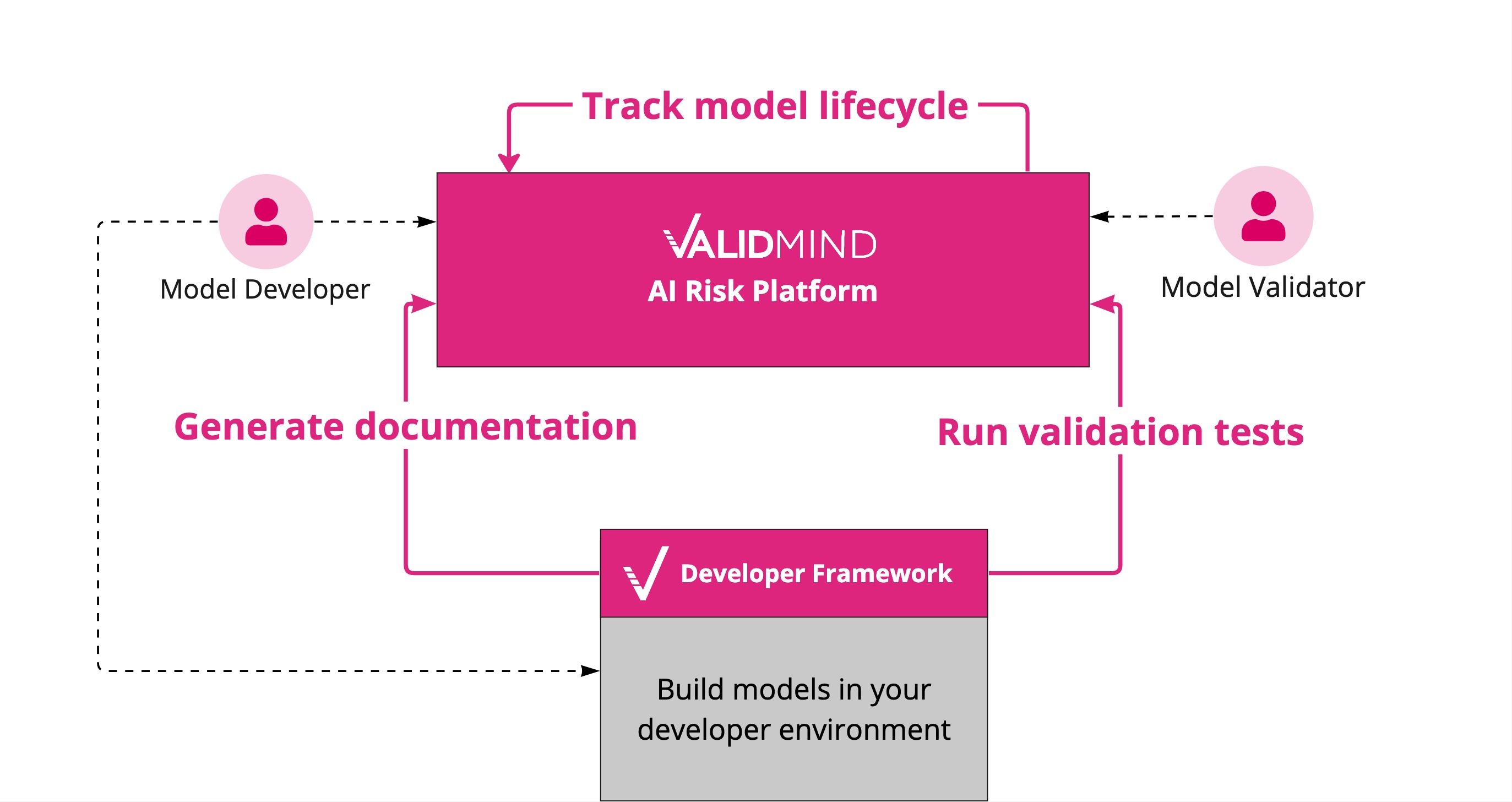
The ValidMind AI risk platform provides two main products components:
The developer framework is a library of tools and methods designed to automate generating model documentation and running validation tests. The framework is designed to be platform agnostic and integrates with your existing development environment.
For Python developers, a single installation command provides access to all the functions:
pip install validmindThe ValidMind Platform UI is an easy-to-use web-based UI that enables you to track the model lifecycle:
- Customize workflows to manage the model documentation and validation process.
- Review and edit the documentation and test metrics generated by the developer framework.
- Collaborate with and capture feedback from model developers and model validators.
- Generate validation reports and approvals.
For more information about the benefits that ValidMind can offer, check out the ValidMind overview.
How do I get started?
On the ValidMind platform, everything starts with the model inventory: you first register a new model and then manage the model lifecycle through the different activities that are part of your existing model risk management processes.
Approval workflow
A typical high-level model approval workflow looks like this:
- New model registration
- Select a documentation template when registering a new inventory model to start your model documentation. You then use the model inventory to manage the metadata associated with the model, including all compliance and regulatory attributes.
- Initial validation
- Triggers a new documentation workflow to yield a model that will be ready for production deployment after its documentation and validation reports have been approved.
- Validation approval
- Perform validation of the model to ensure that it meets the needs for which it was designed. You can also connect to third-party systems to send events when a model has been approved for production.
- In production
- Use the model in production while ensuring its ongoing reliability, accuracy, and compliance with regulations by monitoring the model’s performance.
- Periodic review and revalidation
- As part of regular performance monitoring or change management, you follow a process similar to that seen in the Initial validation step.
Next steps
The fastest way to explore what ValidMind can offer is with our QuickStart:
- Try out the ValidMind Developer Framework
- Explore the ValidMind Platform UI
If you have already tried the QuickStart, more how-to instructions and links to our FAQs can be found under Next steps.
Need an account for ValidMind?
Signing up is FREE — Create your account.